Posts

Showing posts with the label Word Families

The power of one!

Image
Although this article is about a number of significant orthographic principles there are two topics that are particularly pertinent for me: Unravelling the 'story' of one word reveals the intertwined 'stories' of many other words. Investigating <one> clearly demonstrates that meaning and structure are the main concern of English orthography  not pronunciation! Recently, during math week, we investigated the number words, a wonderfully rich source of orthographic understandings. In education, <one> is generally considered a 'sight word' or a 'high frequency word', often a word memorised in isolation. It only seems logical to me, if words are considered  high frequency,  then we should be investigating and analysing them to fully understand the 'how' and 'why' of the spelling. A teacher recently asked, "How can you investigate all the 'sight words'...that seems impossible?" Do you know the singer/songwriter P...
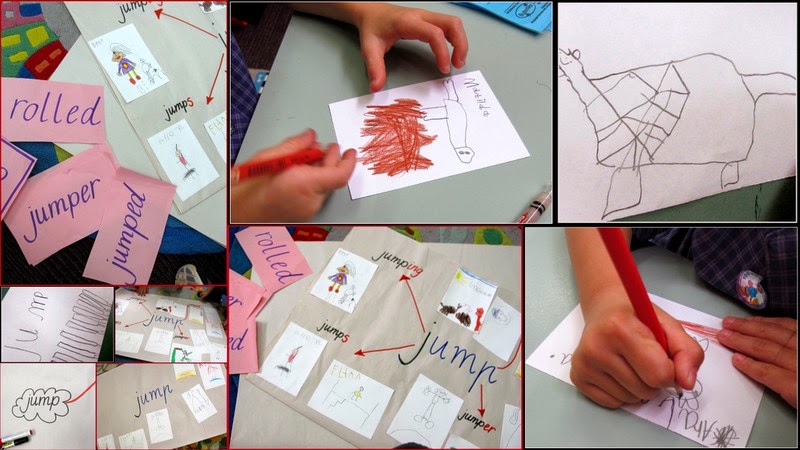
Teaching Orthography in the Early Years: word webs for young children

Image
The primary function of English spelling is to represent MEANING .   Implementing orthography,  through scientific inquiry,  in the early years.  As I continue on my learning journey, and work with young children in a variety of learning settings, it is consistently validated  that teaching morphology to the youngest is not only essential but critical to their success as proficient language users.   As we know and understand from research, morphology is the building block, the solid foundation, for understanding how the English spelling system works. It provides a meaningful structure for teaching and learning phonology in an effective and authentic way. In this post, I would like to share a wonderful learning story of a group of young children who are currently embarking on a journey of orthographic understanding. This structured word inquiry was explicitly embedded in an authentic literacy learning experience, integratin...

Understanding how words are related through MEANING and SPELLING

Image
Building 'word webs' through a collaborative approach . Using a collaborative strategy, Round Table Word Webs ,  students will develop an understanding of the importance of  connecting  SPELLING  with  MEANING,  the essence of the English spelling system.  The students will have an opportunity to build a number of different word webs, by collecting words that all have a common  base . This activity will help students to understand how and why words are related in  'word families'  and how this essential knowledge demonstrates the key to the spelling. Read on for further details regarding this collaborative activity by clicking on the link.